Our platform is the most extensive digital repository of the Northeast's historic, at-risk, and overlooked structures, infrastructure, New York City streets, and other locations.
Photo courtesy of the Winchester Tax Office Pins in the Brook: The Last Ruins of the Union Pin Company J and I came at it through the trees. No path, just tall standing trees and the kind of undergrowth that swats at your shins and grabs your laces, until the canopy thinned and we found what was left. A turbine, tall and rusted, rising out of the woods beside a brook in Winsted, Connecticut. A small generator sat on top of it, also rusted, also still. Beside that, set back from the tree line and facing the residential houses across Lake Street, a sealed and boarded building held its ground. It was August 2019, midday, the kind of heat that slows everything down. We photographed the turbine carefully, then picked our way downstream along the slippery rocks of the brook that fed toward the Mad River past Boyd Street. What J never mentioned, and what I never thought to look for, was the hydropower outlet tucked behind the thick trees just off the path we'd taken. And neither of us eve...
Get link
Facebook
X
Pinterest
Email
Other Apps
Wildcliff Mansion (Cyrus Lawton House) Revisit on Anniversary of Fire
Get link
Facebook
X
Pinterest
Email
Other Apps
A revisit on the anniversary of the arson that claimed this National Historic Place.
A few weeks ago I was in the area and headed up to the now-destroyed Wildcliff mansion in New Rochelle, New York. This unoccupied mansion was torched on November 26, 2018, by four middle school minors. All four teens were caught and found guilty of criminal trespass and one charged with arson. The fire completely destroyed the 1852 mansion that overlooked the Long Island Sound.
Built as a wedding gift for the couple Sarah Marie Davenport and Cyrus Lawton, the cottage villa was designed by architect Alexander Jackson Davis. The historic residence boasts 20 rooms and has the advantage of facing the spectacular scenery of the open water save the now public park structures (Hudson Park) down below the property. According to City Historian Barbara Davis, “Wildcliff, as the Gothic cottage was later renamed, was gifted to the City of New Rochelle by the Julius Prince family in 1940. After having been utilized for city offices the building has housed a variety of not-for-profit groups and functions, including Wildcliff Natural Science Center, East Coast Performing Arts, and Wildcliff Center for the Arts. The interior of the building has not been used for several years; the exterior was restored with funds from the sale of an adjacent property.”
Currently, the property is owned by the City of New Rochelle. The city has created the Wildcliff Advisory Committee to find public uses for the damaged building and land.
Status: Currently standing with no plans for demolition as of yet (Nov 17, 2019)
Address: 42 Wildcliff Road, New Rochelle, New York or 44 Wildcliff Road, New Rochelle, Westchester County, New York
Kings Park and the Education of an Explorer Every pursuit has a place where beginners go first. Skateboarders have their parking lots and curbs. Climbers have their local crags. And if you are just finding your way into the world of urban exploration on Long Island, sooner or later someone points you toward Kings Park. The former Kings Park Psychiatric Center has become, over the years, something like a finishing school for people who don't yet know they're enrolled. Getting onto the grounds is straightforward. Finding a way inside the remaining buildings, if you know where to look, is not much harder. Which is exactly why the Parks Police have written thousands of trespassing tickets here in a single calendar year, why security visibly tightens every Halloween, and why local photography groups have been known to show up with large, enthusiastic crowds of people who want to take what they call "creepy" photos of old hospital asylums. The place attracts everyone, which...
You’ve got to move when the chance is right. That’s something I keep telling myself—but just as often, I forget it. Or ignore it. And then I end up learning the same lesson all over again. It happened on a quiet afternoon when I pulled up to the old Horsman Doll factory. The place has long been abandoned, but it still holds stories—ones I try to capture through my lens. The main gate was slightly ajar. Not wide open, but just enough for me to slip through with my gear. It was one of those rare opportunities. But across the street, half-hidden behind a rundown house, a group of men sat drinking and shouting over each other. The kind of scene you don't want to get caught up in—especially alone, carrying expensive camera equipment. I hesitated. I debated. I bailed. My gut told me to walk away, so I did. I figured I could find another way in. I circled the block, hoping for a back entrance or even a broken window low enough to climb through. I found one window that looked possible—bu...
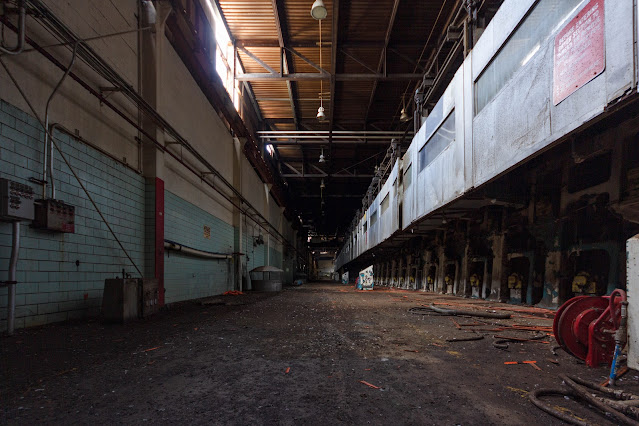
148" Trim Inverformer Paper Machine for Multi-Ply Recycled Boxboard ♻️ Former Fusion Paperboard Plant Series 🌿 Exploring the abandoned Fusion Paperboard recycling facility — from towering paper machinery and hydrapulpers to sludge ponds and the wastewater treatment plant that once supported sustainable recycled paperboard production. 🏭 Part 1 — First Exploration & Main Paper Machine ♻️ Part 2 — Hydrapulpers, Recycling & Sludge Systems 🌱 Part 3 — Wastewater Treatment Facility & Final Exploration 📦 Once producing 100% recycled coated paperboard, Fusion Paperboard recycled over 160,000 short tons of material annually before closing in 2014. I’ll never forget the day my friend J and I wandered onto that sprawling ...
For weeks, I had been orbiting the perimeter of the impending demolition of the Church of St. Michael and St. Edward, a once revered church in the heart of Fort Greene, like a moth drawn to a flame. The neighborhood, a patchwork of tight project housing, seemed indifferent to the fate of this historic edifice. The intel I had received suggested that entry was as simple as scaling a wooden fence, yet the timing had never felt right. Until one day, it did. With a mission in New Jersey looming, I knew it was now or never. The demolition was advancing at a startling pace, the church's twin steeples already reduced to rubble. The skeletal remains of timber beams and rusted steel frames peeked out from the ruins, a testament to the relentless march of progress. Summoning a surge of courage, I seized a moment of quiet in the bustling housing project and vaulted over the fence. My heart pounded in my chest as I slipped unnoticed into the church grounds. The once grand entrance now stood as...
Rockaway Metals Products (RMP) began as a sheet metal fabrication factory beginning in 1961. RMP occupied the site from 1971 to 1987 leaving a plethora of hazardous waste materials onsite. From 1990 to 2004 the building housed various tenants which even included an auto repair shop. Rockaway Metals a manufacturer of filing cabinets and other metal products closed down in 1987. It was leased a few years ago to different owners who did not manage the 4.85-acre parcel. The 155,000-square-foot building has long been an eyesore and trouble in the neighborhood since its closure. A coastal storm in March 2018 blew debris materials to adjacent properties. Rockaway Metals was acquired by Nassau County in 1995 by tax deed. The county has held onto the property for 22-plus years. In February 2011, the site was damaged by fire and condemned soon thereafter. For more in-depth legal ownership of the property, you can read more below in the source list under U.S. v. 175 INWOOD ASSOCIATES LLP. ...


-20.jpg)



Comments
Post a Comment