The building seemed to sag against the Trenton sky, its walls leaning in a way that looked both tired and dangerous. I was driving, searching for a lunch spot after a morning spent exploring the city's industrial skeletons, when I saw it. A questionable choice, maybe, but curiosity is a powerful guide. I pulled over.
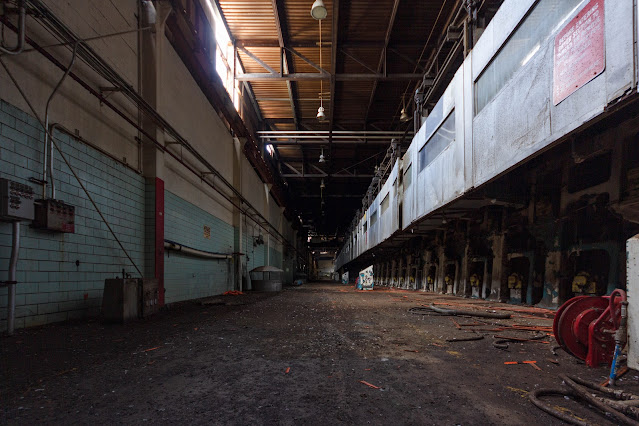
Getting inside was one of the sketchiest entrances I’ve ever attempted. But once my feet were on the dusty floor, the danger faded. An enormous space stretched before me. It was sparse, cleaned out. My footsteps echoed where a stage once stood, a fact I’d later confirm in a NNKH YouTube video about the building’s past life as an underground punk club.
The video showed a vibrant scene, an electric place. But the ghosts of that life were mostly gone. The long, rounded bar, where thousands of hands must have slapped down crumpled bills, had vanished. The dust-coated wine and shot glasses that once lined its shelves were gone, too. The club’s glittering crown jewel, a legendary disco ball, had been saved by a band of former patrons.
Its current location is unknown. I imagine it might surface when the building is finally torn down, its trinkets suddenly valuable to punk rock collectors. Or maybe it’s just sitting in a commercial storage locker somewhere, a silent witness to a thousand forgotten nights.
 |
| Commercial Bakers Pride oven. |
Yet, some relics remained. Tucked away in a small room with a crumbling ceiling, I found shopping carts. They were filled with the ghosts of parties past: expired beer, dusty bottles of wine, and top-shelf liquor, all waiting for a celebration that would never come.
Standing there, in the quiet ruin, I felt a strange connection to the place. This was City Gardens, the iconic Club Bar & Lounge. This was the room where countless punk bands had unleashed their fury. It was the room where a young Jon Stewart once poured drinks behind the bar, long before he became a household name.
Punk rock isn’t my music. But you don’t need to love the music to appreciate the meaning of a place like this. I could almost feel the energy of the crowds that once passed through its double doors, their hearts pounding with excitement. I pictured the dance nights, the admission costing less than five dollars, the hope of a shared glance or a kiss. For a small price, people bought a night of freedom, of shouting lyrics with their favorite bands, and forgetting the world outside.
The club is silent now. The bands and the fans are gone. But standing in that room, I was glad I had pulled over. It was an honor to witness the space where so many memories were made, where a community found its voice, and where the echoes of a legendary past still hang in the dusty air.
From Car Dealership to Punk Mecca: The Building's Origins
What do buckling walls and a sagging roof have to do with punk rock?
Everything. A building is like a person. Before it gets old, it is young. And before it was the legendary punk club City Gardens, the building at Calhoun Street in Trenton lived several different lives.
You might think the story begins with punk rock. It doesn’t. Before the roar of guitars, there was the quiet rustle of paper. The building was a warehouse, stacked to the rafters with religious Bibles. Then, the spirit of commerce moved in. It became US 1 Motors, a car dealership where dreams were sold one vehicle at a time.
But the building’s destiny was not in sales. It was in sound. Around 1976, its identity shifted again. It became an after-hours club named Chocolate City, a nod to the 1975 album by Parliament-Funkadelic. For a few years, it was a home for funk and soul before briefly becoming a straight blues club in early 1979.
 |
| The only thing that remains of the stage is these lonesome stairs. |
Each life left a layer, a memory embedded in the walls.
Then came the chapter everyone remembers. Frank “Tut” Nalbon, whose family had owned the property for years, took the helm. The name on the sign changed to City Gardens. The year was 1979, and while it started with the blues, its future was about to be defined by something much louder.
The club’s beating heart, its true draw, was an event that became a local institution: the 90 Cent Dance Night.
Think about that for a moment. For less than a dollar, you could get in. In an era of five-dollar cover charges, 90 cents was more than a bargain; it was an invitation. Launched on Thursdays by DJ Randy Now in 1980 and later championed by DJ Carlos, these nights were a magnetic force. The music was a potent mix of new wave, alternative, and industrial rock, sounds you couldn’t hear on the radio.
And people came. At first, it was hundreds. Soon, the weekly dance nights were pulling in 700 to 1,000 clubgoers. At its absolute peak, the number swelled to 1,500 people a week, a river of bodies flowing through the doors, all for less than a dollar. The price eventually crept up to 95 cents in 1983, but it stayed under a dollar for more than a decade.
So when you look at the buckling walls of that building today, you’re not just seeing decay. You’re seeing the physical trace of a history. The walls absorbed the quiet reverence of a Bible warehouse, the ambition of a car dealership, and the smooth groove of Chocolate City.
But mostly, they absorbed the furious, joyful energy of punk rock. They held the vibrations of thousands of kids dancing, finding a community, and sweating out their week for the magical price of 90 cents. The club lived one final life as a venue called Club XL before the music stopped for good. The building didn’t just host punk rock. In a way, it lived it: loud, defiant, and unforgettable.
If a music venue could have a resume, City Gardens Club would be unbelievable. The list of acts that played City Gardens reads like a hall of fame induction booklet. The Ramones played there 25 times. Bands like A Flock of Seagulls, the Thompson Twins, and Sinéad O’Connor made their American debuts on its stage.
The Bands: Ramones, Nirvana, Ween, and 4,000 More
So how did a club in Trenton, New Jersey, become the center of the music universe for a generation?
The answer is a man named Randy Ellis, better known as Randy Now. From the late 1970s through the mid 1990s, Ellis was a mailman by day. But by night, he was the visionary booker for City Gardens, the architect of its legendary status. With a golden ear and a phone book full of contacts, he curated a constant stream of culture that defied the club’s humble location. Over his tenure, more than 4,000 bands played the venue.
The stage at City Gardens welcomed and endured a staggering collection of artists. It was a home for punk icons like the Dead Kennedys, Black Flag, and Bad Religion. It hosted the raw power of Nine Inch Nails, Iggy Pop, and Slayer. Rising stars like R.E.M., Green Day, and Nirvana played there, sometimes before the rest of the world knew their names. The roster spanned genres, from The Offspring, Public Enemy, 3rd Bass, GWAR, Suicidal Tendencies, Venom, Buzzcocks, Danzig, L7, Circle Jerks, Rollins Band, Joe Strummer, MC Lyte, Lydia Lunch, Bouncing Souls, Nils Lofgren, Maytels, Toots, Motorhead, Faith No More, Primus, Sonic Youth, Discharge, George Clinton, The Cramps, Mindfunk, Plasmatics, Wall of Voodoo, Nikki D, Danzig, Morbid Angel, De La Soul, Fugazi, Henry Collins, Black Train Jack, Bad Brains, English Beat, Soundgarden, Beastie Boys, Billy Idol, Semibeings, Butthole Surfers, Scorn Flakes, GHB, Fear, The Replacements, Bouncing Souls, Devo, Violent Femmes, Warrant, They Might Be Giants, Megadeth, Gorilla Biscuits, Corrosion of Conformity, Nirvana, Kurt Cobain, NOFX, New Order, Ned’s Atomic Dustbin and Mighty Mighty Bosstones.
But the club’s gravity pulled in more than just musicians. The counterculture icon Timothy Leary lectured from the stage. The comedian Henny Youngman told jokes there. And behind the bar, from 1984 to 1987, a young Jon Stewart slung drinks. A few years later, James Murphy, who would go on to form LCD Soundsystem, worked security as a bouncer for the club’s hardcore shows.
The venue became a cultural incubator. The band Ween, from nearby New Hope, Pennsylvania, practically grew up on its stage, playing there as teenagers. The club’s unique atmosphere even inspired R.E.M. guitarist Peter Buck to write the song “Perfect Circle.”
Like all great eras, it had to end. Randy Now booked Ween for the final show on December 2, 1994. The reasons for the club’s demise were a familiar mix. Rents went up, musical tastes shifted, and periodic clashes with local authorities took their toll. But mostly, it was just the end of an era. The building changed hands a few times, eventually falling into the city of Trenton’s possession before being auctioned to a private developer in 2019.
Today, the building is a ghost. Large cracks run down its face. The cinderblock walls are separating, leaning precariously away from the foundation. But while the physical structure is failing, the story of City Gardens is stronger than ever.
Its legacy is chronicled in books such as No Slam Dancing, No Stage Diving, No Spikes by Amy Yates Wuelfing and Steven Dilodovico, and in the documentary Riot on the Dance Floor. These projects prove that a place is more than just bricks and mortar. For a brilliant, chaotic moment in time, a building in Trenton became a legend. And a legend, unlike a building, can last forever.
Closure and Aftermath: What Stands There Today
Every story has an ending.
For the legendary City Gardens, the end is not a sudden crash or a dramatic explosion. It is a slow, quiet surrender. The building is coming apart, cinderblock by cinderblock. The walls that once vibrated with the sound of The Ramones and R.E.M. are now separating, leaning away from a foundation that has held up a half-century of cultural history.
City officials in Trenton see the decay. They know the walls are failing. But the building stands on private property, and as long as it doesn’t pose an immediate public hazard, their hands are tied. The responsibility falls to its current owners, a company that bought the property at auction in 2019. Reports indicate they owe thousands in back taxes, and the building’s slow-motion collapse seems to be a low priority.
This quiet demolition by neglect is happening against a familiar backdrop: gentrification. As Trenton marches toward a newer, shinier version of itself, pieces of its raw, authentic past are being left behind to crumble.
But a building and its memory are two different things.
While the physical structure withers, the soul of City Gardens is being carefully preserved. Photographer Ken Salerno was there through the years, capturing the lightning in a bottle. His lens immortalized the sweat-drenched musicians and the ecstatic faces in the crowd, freezing moments of pure energy within the club’s inner sanctum. His work ensures that the people who graced the stage and filled the dance floor will not be forgotten.
And for those who want to travel back in time, the digital world offers a doorway. Online archives, like the collection at east_coast_punk_archives, showcase the club’s memorable flyers. These grainy images and bold graphics are more than just nostalgia. They are artifacts. They are proof of what was.
🎸 Did You Go to City Gardens?
Were you there for 90 Cent Dance Night? Did you see Nirvana, Ramones, Ween, or Bad Brains? Do you have flyers, ticket stubs, photos, or memories from inside the club? Your story is part of Trenton's cultural history and deserves to be preserved.
Drop a comment below or contact me directly. Full credit given to all contributors.
🎸
More New Jersey Lost Landmarks & History
Source(s):
1. Shea, K. (2022, December 1). Legendary punk rock hall City Gardens is abandoned, in 'imminent danger' of collapse. NJ.com. https://www.nj.com/mercer/2022/12/legendary-punk-rock-hall-city-gardens-is-abandoned-in-imminent-danger-of-collapse.html
2. Minnick, K. (2020, April 30). With an undying passion for music, Ellis doing all he can to keep Man Cave afloat. NJ.com. https://www.nj.com/coronavirus/2020/04/with-an-undying-passion-for-music-ellis-doing-all-he-can-to-keep-man-cave-afloat.html
3. Stilton, P. (2026, January 16). Remembering New Jersey’s Underground Rock Mecca, City Gardens. Shore News Network. https://www.shorenewsnetwork.com/remembering-new-jerseys-underground-rock-mecca-city-gardens/
4. Daylight Books. (2014, October 2). Riot on the Dance Floor: The Story of City Gardens told at last. https://daylightbooks.org/blogs/news/17202745-riot-on-the-dance-floor-the-story-of-city-gardens-told-at-last
5. Trenton Daily. (2019, September 10). City Gardens, a little-known trailblazer in its time. https://trentondaily.com/city-gardens-a-little-known-trailblazer-in-its-time/


-20.jpg)


Comments
Post a Comment