Our platform is the most extensive digital repository of the Northeast's historic, at-risk, and overlooked structures, infrastructure, New York City streets, and other locations.
Photo courtesy of NYC Municipal Services / 1940s.nyc From Mack Trucks to Apartments: A Century on Empire Boulevard For most of the twentieth century, the block at 73-99 Empire Boulevard in Crown Heights handled the heavy work of the city. Trucks came in for service. Tires were swapped out. Parts were stocked and sold. The buildings on this stretch of Brooklyn were built for vehicles, and for about sixty years, that's exactly what they served. The site directly neighbors the much taller Ebbets Field Apartment complex, which is the housing that replaced the ballpark. By 2025, both were rubble. By September 2026, the foundation of a 13-story apartment building was going in. A hundred years of industrial and automotive history on a single block, cleared in a matter of months. The main building at 73-99 Empire Boulevard went up in 1925 and opened as a Mack Truck auto service facility. At 29,000 square feet, it was built for the scale of commerc...
Get link
Facebook
X
Pinterest
Email
Other Apps
Abandoned Caribbean Island House
Get link
Facebook
X
Pinterest
Email
Other Apps
Outside view.
It was a balmy morning on my two-week vacation on the Caribbean island. Just that morning, I took my early morning walk before the sun peeped its head over the clouds. During our circular route around the neighboring countryside village from where I was staying. We came upon a small narrow path delineated by the countless footsteps of many people who used this shortcut to get back over on the other side, then going around the main road. Walking this well-beaten path, we came upon a small gaping limestone cave. The small cave didn't go any deeper than maybe 10 feet. A pile of dead plant matter, household garbage, and abandoned bird nests were all that was on offer from this discovery. If I wanted deep cave exploration, I would have headed to the tourist limestone cave tour the island is known for on the southwest of the island.
A very small cave.
We continued onward to our accommodation. After refueling myself with a hearty breakfast. I packed my camera gear and headed back out to the beaten path once more to poke around some more. On another path through the thicket of bushes, young tree saplings, and knee-high grass, I came upon a small abandoned board house tucked away inside the small area of overgrown foliage between neighboring houses and the main side road. No evidence of human usage was apparent around the outside. The board house was surrounded and entwined with small trees and saplings. Nature had taken its course with this derelict house.
Inside the house, from the view of the front room had already caved in a long time ago. The floor in certain parts had caved into itself to the ground. One part of the boarding house was entirely covered by what looked like walnut husks, and the other side had what remained to be a box spring bed sans mattress bedding. Further back inside the house was unreachable due to the aforementioned collapsed roof and absent flooring. Guessing by the remaining structure of the house, the house, give or take, may have been there for more than 10 years. No apparent evidence of termites or extreme wood rot in sight; I would say the house was constructed with hardy wood like mahogany. Although the climate is sustained yearly with 80-degree weather, with a few months out of the year starting in October for the rain and hurricane season. The house was surprisingly in fair condition.
Living room.
No more bedroom here.
The direction to the kitchen/bathroom.
Satisfied with my discovery and pictures. I headed further out from the house until I came out into a clearing studded with the back views of wall houses in the distance. There will be no more abandoned spots in this area. With that dilemma, I headed back home before I drowned in my own sweat with the rising sun and the mercury-raising temperatures climbed even higher.
Side view.
P.S. Before heading to this island, I researched abandoned properties, but to my dismay, Google Street View does not exist in the countryside or the city. In addition, Google Maps' clunky what's here feature was useless for map coordinates when Google Maps was a nonexistent map tool for further exploration. I found other areas of interest sweeping the island using Google satellite images, but getting there was an issue since I did not have relevant information on locale or addresses. Island villages are way different than small towns or cities in the USA.
🏝️ Have You Ever Explored An Abandoned Caribbean Island House or Building?
Have you ever stumbled upon a hidden structure while traveling off the beaten path — an abandoned house, a forgotten ruin, a hotel, a former plantation or a mysterious cave? Do you have photographs of these structures tucked away in the thicket, or memories of discovering secluded spots during your own Caribbean adventures?
🌎 More Abandoned Places & Off-the-Path Explorations
From tropical ruins and forgotten island houses to industrial relics and repurposed landmarks — follow the trail of discovery around the world and closer to home.
Kings Park and the Education of an Explorer Every pursuit has a place where beginners go first. Skateboarders have their parking lots and curbs. Climbers have their local crags. And if you are just finding your way into the world of urban exploration on Long Island, sooner or later someone points you toward Kings Park. The former Kings Park Psychiatric Center has become, over the years, something like a finishing school for people who don't yet know they're enrolled. Getting onto the grounds is straightforward. Finding a way inside the remaining buildings, if you know where to look, is not much harder. Which is exactly why the Parks Police have written thousands of trespassing tickets here in a single calendar year, why security visibly tightens every Halloween, and why local photography groups have been known to show up with large, enthusiastic crowds of people who want to take what they call "creepy" photos of old hospital asylums. The place attracts everyone, which...
For weeks, I had been orbiting the perimeter of the impending demolition of the Church of St. Michael and St. Edward, a once revered church in the heart of Fort Greene, like a moth drawn to a flame. The neighborhood, a patchwork of tight project housing, seemed indifferent to the fate of this historic edifice. The intel I had received suggested that entry was as simple as scaling a wooden fence, yet the timing had never felt right. Until one day, it did. With a mission in New Jersey looming, I knew it was now or never. The demolition was advancing at a startling pace, the church's twin steeples already reduced to rubble. The skeletal remains of timber beams and rusted steel frames peeked out from the ruins, a testament to the relentless march of progress. Summoning a surge of courage, I seized a moment of quiet in the bustling housing project and vaulted over the fence. My heart pounded in my chest as I slipped unnoticed into the church grounds. The once grand entrance now stood as...
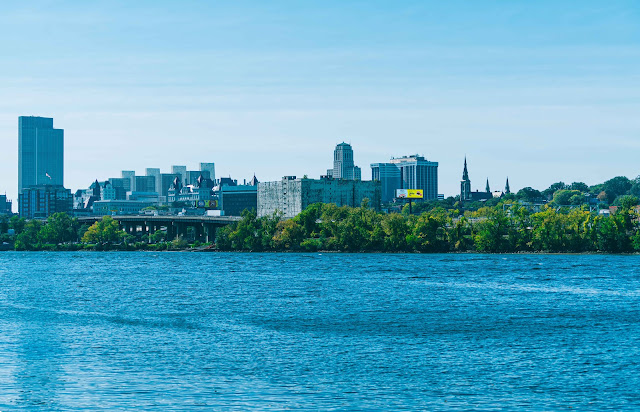
In the heart of Albany, nestled amidst the echoes of its bustling past, lies an abandoned warehouse, a treasure trove of stories untold until now. This isn't just any derelict structure; it's the cornerstone of my urban exploration journey, the first of many, but forever the one that initiated me into the world of forgotten spaces. Let's call it the ultimate introduction, the genesis of a passion that has since defined my adventures. Our story begins on a crisp, cold morning that promises adventure. I vividly remember the excitement bubbling up as I set off to pick up my companion, referred to here as "A," from Queens. The journey from the familiar streets of our neighborhood to the unknown mysteries of Albany stretched over three hours, a pilgrimage to our very own urban Mecca. We arrived ahead of schedule, anticipation building as we waited in the chilling embrace of dawn, our breaths visible in the air, our spirits undeterred. Our early morning venture led us t...
A former coal-fired power plant in Yonkers sits quietly by the waterfront, its redevelopment ambitions repeatedly running aground against community resistance and logistical hurdles. Once an industrial hub, the site has spent years in limbo, tangled in unrealized visions of transformation and contention with local stakeholders. The most recent development proposal called for a 157,000-square-foot mixed-use office space. However, the Yonkers Planning Board faced strong pushback from residents. Parking became a flashpoint, with the community voicing concerns over how the new project would accommodate vehicles. Efforts by the developer to secure parking access at nearby Trevor Park and the John F. Kennedy Marina were met with such resistance that the plans were scrapped altogether. Adding to the tensions, critics took issue with the property owner's financial contributions to the city. Many residents felt the developer had been avoiding paying a fair share of Yonkers' property tax...
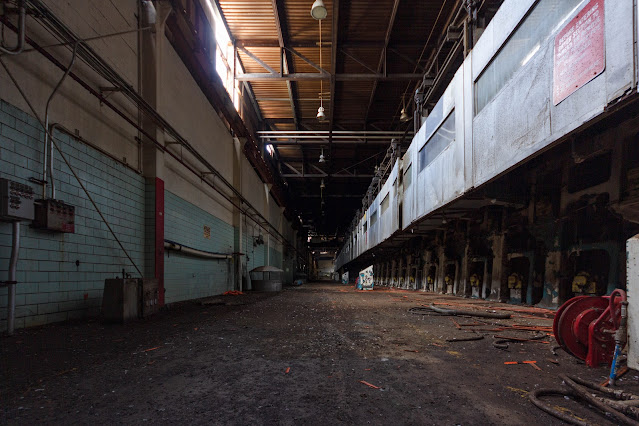
148" Trim Inverformer Paper Machine for Multi-Ply Recycled Boxboard ♻️ Former Fusion Paperboard Plant Series 🌿 Exploring the abandoned Fusion Paperboard recycling facility — from towering paper machinery and hydrapulpers to sludge ponds and the wastewater treatment plant that once supported sustainable recycled paperboard production. 🏭 Part 1 — First Exploration & Main Paper Machine ♻️ Part 2 — Hydrapulpers, Recycling & Sludge Systems 🌱 Part 3 — Wastewater Treatment Facility & Final Exploration 📦 Once producing 100% recycled coated paperboard, Fusion Paperboard recycled over 160,000 short tons of material annually before closing in 2014. I’ll never forget the day my friend J and I wandered onto that sprawling ...


-20.jpg)


This comment has been removed by a blog administrator.
ReplyDeleteEmail me so I can add you to my Google Maps list.
Delete