📜
Start from the Beginning
Strathmore Paper Mill No. 1
The first part of the Strathmore exploration—where it all began on that sweltering July day.
The July heat of 2017 hung heavy over Woronoco Road, but that did nothing to diminish the sight before us. Strathmore Paper Mill No. 1 stood like a monument to another era, its weathered brick facade still holding strong against time. Behind the mill, the Woronoco Falls provided a constant soundtrack, the rushing water a reminder of why this spot was chosen for industry more than a century ago.
My friend J and I had made the trip along Old Route 20 specifically for this place. The mill looked untouched, almost frozen in time, save for the expected cluster of "No Trespassing" signs posted along the perimeter. Across the street sat the warehouse, sometimes called Mill No. 3, connected to our target by an old catwalk that stretched between the two red brick structures. We studied it from a distance, hoping for an angle of approach, but access proved impossible that day. The catwalk taunted us with what could have been.
Still, we had come too far to leave empty-handed. We spent the afternoon documenting Mill No. 1, capturing what we could under that punishing summer sun. When we finished, our attention turned to the larger prize just across Bridge Street. The 233,000-square-foot Strathmore Paper Mill No. 2 waited there, but reaching it required some creativity.
The bridge itself had been blocked off, forcing us to take an alternate route. We made our way along Valley View Avenue, walking as casually as two people can walk when they know full well that any neighbor on their porch would have every reason to pick up the phone. Each house we passed felt like a small test. We kept our heads up, our pace steady, and our nerves quietly frayed.
Luck was on our side. The porches were empty that afternoon. No curious eyes, no confrontations, no blue lights in the rearview. We reached the old paper mill without incident, grateful for the quiet and ready to explore.
 |
| Bee boxes?!?!?! |
Outside the mill, a curious sight greeted us. Old beehive boxes and wooden crates sat stacked beneath a small overhang, wrapped up and waiting for a purpose that would never come. Running alongside the building was a rail siding, a quiet stretch of track that once hummed with activity. In the mill's working days, trains from the Boston and Albany line, and later Penn Central, would pull up to these very rails. Workers loaded finished paper products onto freight cars and unloaded raw materials through wide bay doors. Now the tracks sat rusted and silent, slowly being swallowed by weeds.
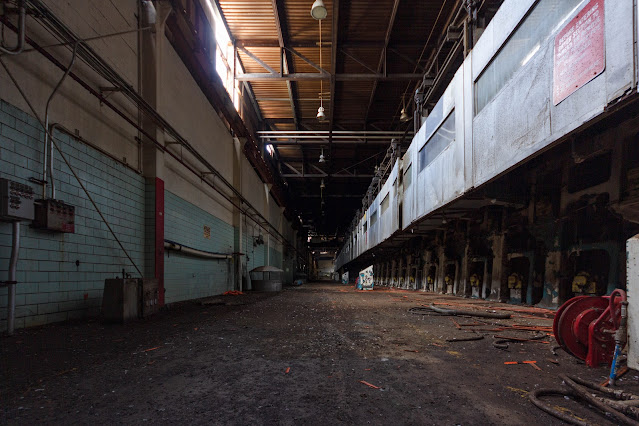
Inside the mill, we found a time capsule of industrial production scattered across various rooms. Boxes upon boxes of cardboard sat in towering stacks. Endless rolls of plastic labels caught our attention, branded packaging for tea companies and other consumer goods that never made it to store shelves. Metal press rolls sat on the ground. Paper and plastic confetti, the colorful waste product of die-cut operations, lay in heaps. Bales of recycled cotton, compressed and wrapped, sat alongside massive rolls of fabric. Random pieces of household furniture had been dragged in at some point, and different grades of paper stock collected dust in forgotten corners.
Looking back now, the sheer volume of flammable material makes what happened next feel almost inevitable. A fire eventually tore through this building and reduced it to ruin. Someone, whether a careless arsonist or bored teenagers chasing social media clout, decided that destruction was more interesting than discovery.
 |
| Rolls of tea bag packaging and other consumer labels lay on wooden pallets everywhere. |
 |
| I wish I had paid more attention to the machinery inside this room. |
 |
| 1 million safe hours and 3 years of no lost work days on May 18, 1996. What a milestone! |
 |
| Rolls of fabric and flattened cardboard boxes tilt in various directions all over. |
 |
| Mushroom columns on the ground floor. |
It pains me to think about it. There was a time when exploring these places came with an unwritten code. You took photographs. You took memories. You left nothing but footprints. That ethic seems to have faded six years ago, replaced by a reckless disregard that leaves scorched walls and shattered windows in its wake. Envious latecomers, content creators hungry for viral moments, and restless youth with no respect for history now treat these sites as playgrounds for destruction. The places that survive are becoming fewer each year.
But on that July afternoon, the mill still stood intact, and the true gem of our visit awaited us in the steam power and filter plant.
This section of the complex took my breath away. A towering yellow brick smokestack dominated the exterior, its name spelled out in contrasting dark brick for anyone approaching to see. Inside, the space exploded with color in a way I had never encountered in years of exploring old boiler houses and power plants.
Yellow hand railings traced pathways along elevated platforms. Green paint coated the heavy steel support beams. The housing of the steam turbine wore a brilliant shade of blue. White asbestos insulation, now covered in a fine layer of black dust, wrapped around the old steam pipes like bandages on sleeping giants. The walls themselves seemed patriotic, painted in panels of red, white, and blue. Rust-colored catwalks crisscrossed overhead, connecting different levels of the operation.
 |
| Someone, or a former owner, absconded with the highly valuable turbine blades. |
 |
| So many colors! |
I have walked through dozens of power plants over the years. Modest boiler rooms tucked into different sections and rooms, and cold basements of textile mills. None of them compares to this. The Strathmore steam plant was a painter's palette disguised as industrial infrastructure, and standing in the middle of it felt like stepping inside a piece of forgotten art.
By the time we made our way out, the afternoon sun had begun its slow descent to more bearable conditions. We had explored the mill from top to bottom, documented what we could, and walked away with the kind of quiet satisfaction that only comes from a day well spent. Strathmore Mill No. 2 had delivered everything we hoped for and then some.
Strathmore Mill No. 2 rose from the banks of the Westfield River in 1913, the work of architects from the Samuel M. Green Company. The original design featured a distinctive U-shaped footprint, a practical layout that allowed for efficient workflow and natural light from multiple angles. Over the decades that followed, the building grew along with demand.
Expansions came in 1919 and again between 1920 and 1921. The 1940s likely brought additional remodeling, though records from that era remain murky. At some point in more recent years, a large metal-clad addition was bolted onto the structure, a functional but visually jarring appendage that clashed with the character of the original brickwork. The roofline told the story of these changes, mixing flat sections with monitor roofs that once flooded the production floors with daylight. A concrete entryway, simple in its post-and-beam design, appears to date back to the original construction.
Just south of the main mill building stands the Steam Power and Filter Plant, built at the same time as Mill No. 2. The plant is a compact structure organized into three distinct blocks, modest in size but essential to the operation it once served. Its most striking feature is the towering smokestack made of yellow brick, with the name Strathmore Paper Co. spelled out in darker brick for all to see. That smokestack became the signature of the entire complex, visible for miles and a source of local pride for generations.
 |
| Control panel inside the filter plant. Photos courtesy of my friend J. |
 |
| Screen filter machine inside the filter section. Photos courtesy of my friend J. |
The story of the mill took a hopeful turn in May 2019 when a Pittsfield developer named Jacob Trudeau purchased Strathmore Mill No. 2 at auction. The winning bid came in at just $15,000, a bargain price for a property with serious potential. Trudeau had plans to convert the facility into a cannabis cultivation and processing operation, joining a wave of entrepreneurs looking to capitalize on the legal marijuana market in Massachusetts.
That dream went up in smoke, quite literally, in June 2020.
A fire broke out at the mill and burned for three consecutive days. By the time firefighters brought it under control, two-thirds of the complex had been destroyed. The fuel for this inferno came from the same materials we had seen during our visit three years earlier. Those giant rolls of paper, abandoned since the 1990s, fed the flames like kindling in a fireplace. According to reporting from Mass Live, the blaze was catastrophic, and it was only the first of many.
Since that initial fire, four additional blazes have struck the Strathmore complex, affecting both Mill No. 1 and Mill No. 2. Each incident has compounded the damage and pushed any hope of redevelopment further into the distance.
Despite the setbacks, the Trudeau brothers have not abandoned their vision entirely. Their proposed development, dubbed Woronoco City, reads like something out of an urban planning fever dream. The plans call for 168 high-end rental apartments. Thirty condominiums styled after the luxury units found in Aspen. A co-working space complete with a small observatory for stargazing. A vertical farm connected to a ground-floor grocery market. A restaurant. A shop catering to hikers and cyclists. A fitness center with a full spa.
It is an ambitious proposal, perhaps overly so, for a town that has struggled economically for decades. The gap between the glossy renderings and the reality on the ground feels vast.
One element of the original complex will survive regardless of what happens next. The developers have committed to preserving the landmark Strathmore smokestack, that yellow brick tower that has defined the skyline for more than a century. Whatever rises from the ashes, the smokestack will remain as a connection to the past.
The former Woronoco Mill property spans 27.8 acres near the junction of Routes 20 and 23, with the Westfield River providing a scenic border along one edge. Various proposals continue to circulate. Senior housing remains a possibility. Cannabis cultivation is still on the table. Mixed-use development attracts periodic interest from outside investors.
But progress has stalled, and the reasons are not hard to understand. The series of fires has created a cleanup nightmare that must be addressed before any construction can begin. Environmental remediation on a site with this much damage requires significant capital, and questions linger about whether the current developer has either the financial resources or the appetite to see it through.
For now, the Strathmore complex sits in limbo. The smokestack still stands tall against the Massachusetts sky, a proud relic waiting to see what the future holds. Whether Woronoco City ever materializes or the property changes hands once again, the story of this place remains unfinished.
If you have a connection to any of these vanished workplaces—whether you spent time on the floor of Strathmore Paper Mill, or have preserved a fragment of their history in your family's life, a photo, a video, a product, an employee badge, a catalog, or an old advertisement—I would be honored to share your piece of the story here. These tangible memories and personal accounts are what truly animate the silent shells we see today; they give voice to the past in a way that maps and corporate filings never can. Every image or recollection you share helps to fill the gaps, honoring the skill and community that once filled these now-quiet spaces. Please feel welcome to contribute, and know that you will be fully credited for helping to preserve this important chapter of our local heritage.


🎨 Did You Work at Strathmore Mill No. 2?
Were you employed at the Woronoco mill before its 1999 closure? Do you remember the colorful steam plant when it was still pristine—the yellow railings, green beams, and blue turbine housing? Share your photos and memories below.
Drop a comment below or contact me directly. Full credit given to all contributors.
🔥
More Mills Lost to Fire & Time
Source(s):
1. Thomas, K. (2022, April 5). Former Strathmore Paper Mill property projected to be residential, mixed-use area. WWLP.com
2. Canton, D. (2020, June 20). Multiple MA Departments Battle Vacant Mill Fire. Firehouse.
3. Kinney, J. (2022, April 10). ‘Woronoco City’: Owners of vacant Strathmore mills in Russell have big plans for housing, commercial development. Mass Live.
4. Shook, A. & O'Keefe, J. (2024, July 18). Montague awarded $4.9M to cleanup former Strathmore Mill complex.
WWLP.
5. Hoffman, E. (2024, November 14). Montague officials react to collapse of Strathmore sister mill in Russell.
Greenfield Recorder.
6. Klein, A. (2024, November 11). 3 hurt, 1 critically, in Mass. abandoned mill collapse.
10 Boston.
7. Kinney, J. (2023, April 10). Woronoco City’: Owners of vacant Strathmore mills in Russell have big plans for housing, commercial development.
Mass Live.
9. Oliver, L & O'Connor, S. (2022, July 26). 4-alarm fire ravages Strathmore Mill building in Russell.
Western Mass News.
10. Russell Mill Fire Started Accidentally with Oxy-Acetylene Torch.
Mass.gov
11. Walden's Stationer and Printer. (1903). United States: (
page 19)
13. Smith, J. (2020, June 22). Pittsfield man sees prospective cannabis facility go up in smoke. The Berkshire Eagle.


-20.jpg)



Comments
Post a Comment