The long-vacant medical office building at 116 Cook Avenue is finally gone. In its place, city leaders want to build a combined senior center and health department campus that would replace the aging senior center on West Main Street and the leaking Health and Human Services office on Miller Street. It is a big swing at a stubborn problem, and it comes with a price tag and a timeline that have sparked fresh debate.
The city bought the Cook Avenue property in 2009 for $700,000. It secured $2 million for demolition, and the City Council approved $25 million in bonds to build the new center, which is slated to open in 2027. With the old building demolished, officials say the site is shovel-ready and more attractive for state funding.
There is one wrinkle. The property sits in the city’s flood plain. That issue has been less of a concern during planning because of the Harbor Brook flood control project. But delays with that work have stretched the timeline and reopened a practical question at City Hall. Should the city renovate the current senior center on West Main Street instead, finish faster, and save money? That conversation is now back on the table, even as the Cook Avenue plan moves ahead.
Designers have pitched a center that serves as a true hub for older residents and public health. Plans call for a core program area with dining space, activity rooms, and meeting rooms. Designers have also floated ideas for a small gym or walking track. Residents say they want outdoor space too. They have asked for a walking trail, places to gather and garden, and possibly a few outdoor courts.

Across the late nineteenth century, the site grew into a crowded corridor of industry, where silverware makers and gunsmiths built side–by–side communities of fire, metal, and grit. On the west side of the Pilgrim Harbor Brook, C. Rogers and Bros. expanded their silverware works from a modest cluster of plating and machining rooms into a larger complex that kept adding departments as the years rolled forward. Coal and kerosene fed the early furnaces, and by 1891, an aging gasometer stood on the grounds as a reminder of how quickly the operation had scaled. Meanwhile, the east side of the property carried the distinctive rhythm of Parker Brothers, whose gun shops relied on foundry heat, machining floors, and later forging rooms to shape the firearms that built their reputation. Their footprint stayed steady through the turn of the century, even as the facility took on new names and added features like a rifle range, signaling a business adapting to its era.


By 1901, both sides of the brook had become firmly established manufacturing anchors, and the landscape reflected that maturity. The western buildings held their expanded form, while the eastern shops continued under the Chas. Parker Co. name. Still, the most dramatic visual shift arrived mid–twentieth century, when the Sanborn maps first identified the sprawling International Silver Company’s “Factory H.” The transformation was especially clear in the southern end of the property, where construction filled in large swaths of open ground. Bridges and later Building B physically connected the two halves of the operation across the brook, turning the site into a single, integrated industrial organism. Boiler houses, oil bunkers, and service utilities soon followed, marking the site’s transition from nineteenth-century millwork to modern industrial production.
By the time the 1950s and 1970s maps were drawn, the site had reached its full structural expression. Buildings A, B, C, and D stood in recognizable form, supported by parking lots, smokestacks, twenty-five metal dust collectors, and a water tower that signaled the scale of activity within. Though the maps noted only modest changes after 1953, the aerial photographs later confirmed subtle shifts, including vegetation creeping across the east side of Harbor Brook and the eventual demolition of Building D by the mid–1980s.
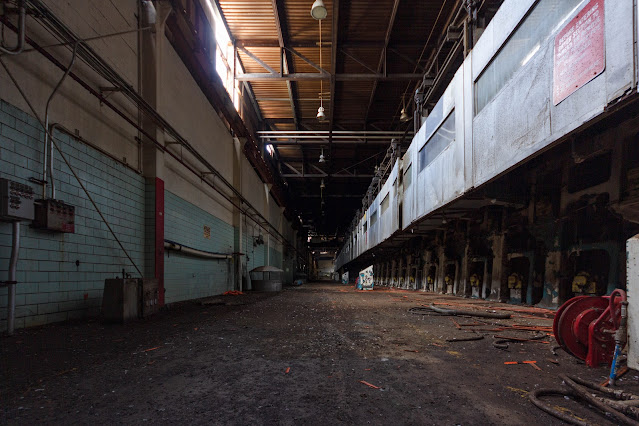
The complex was converted to medical offices in the 1970s and was used by Meriden Medical Center until around 2000. After that, it sat empty. The building fell into disrepair. It drew squatters and vandals. Fires broke out, including the last one in February 2022. A homeless cooking accident years earlier destroyed much of the front facade. Neighbors saw it as a blight on lower Cook Avenue. Kids in the neighborhood used it as a dangerous playground.
Demolition began in earnest in March 2025, when Mayor Kevin Scarpati helped take down the front entryway of the roughly 75,000 square foot structure. It was a visible start to a broader cleanup along Harbor Brook (formerly Pilgrims Harbor Brook). Earlier phases removed other pieces of the old industrial complex. A $200,000 grant was paid to tear down the former International Silver Company Factory H power plant and boiler house east of the brook. The larger sawtooth building and its connector came down before that, and a small transformer house built over the water was removed years earlier. Clearing those pieces did more than improve the view. It made it possible to imagine a new public campus on the site.
 |
| The 4-story former factory and commercial/medical building |
This is not the first idea proposed for Cook Avenue. In 2014, a developer pitched a mixed-use plan with street-level commercial space and dozens of apartments. That plan would have added up to 86 housing units and more than 35,000 square feet of storefronts when combined with Factory H. It stalled. Developers showed interest through the years, but nothing stuck. Earlier this year, the council ended that chapter with a tie-breaking vote to put the new senior center on the site instead.
The money and timeline are now front and center. The city has already demolished the building and approved construction bonds. The 2027 target gives time to finish designs, bid the job, and coordinate with the flood control work. At the same time, the delays on Harbor Brook have led some to argue for a smaller fix first. Renovating the existing West Main Street senior center could cost much less and be done sooner. Supporters of the Cook Avenue plan say the new campus would deliver better services under one roof and give the health department a modern home.
Residents have a stake in the decision because they will use the building and pay for it. Seniors want more space for meals, classes, and social time. Caregivers and families want a place that feels safe and easy to reach. Public health workers require rooms dedicated to clinics, testing, and community programs. The Cook Avenue plan aims to address all of this in one location, featuring outdoor areas that invite people to walk, sit, and connect.
There are practical questions left to sort out. How will the city phase construction alongside flood control work on Harbor Brook? What mix of state funding can be secured now that the site is shovel-ready? Which amenities make the most sense for the budget and the neighborhood? And if the council pursues a quick renovation on West Main Street, how would that change the scope or timing of the Cook Avenue build?
What is clear is that Cook Avenue has turned a corner. The decrepit office block is down. The brownfield cleanup has pushed the site toward a new purpose. After years of false starts, the land is finally ready for something public, useful, and built to last. The next few months will show whether the city doubles down on the new campus or tackles a faster renovation first while Cook Avenue takes shape.
Either way, the goal is the same. Replace outdated, leaking spaces with a center that treats older residents with care and gives public health workers the tools they need. The city has a rare chance to turn a long-troubled property into a place that serves people every day. Now it has to follow through.
If you have a connection to any of these vanished workplaces—whether you spent time on the floor of Meriden Medical Center office, or have preserved a fragment of their history in your family's life, a photo, a video, a product, an employee badge, a catalog, or an old advertisement—I would be honored to share your piece of the story here. These tangible memories and personal accounts are what truly animate the silent shells we see today; they give voice to the past in a way that maps and corporate filings never can. Every image or recollection you share helps to fill the gaps, honoring the skill and community that once filled these now-quiet spaces. Please feel welcome to contribute, and know that you will be fully credited for helping to preserve this important chapter of our local heritage.
🩺 Did You Work at the Meriden Medical Center?
Were you a healthcare worker, patient, or visitor at this facility? Do you have photos from when the center was operational, or memories of the care provided within these walls? Your firsthand accounts honor the people and purpose that once filled these rooms.
Drop a comment below or contact me directly. Full credit given to all contributors.
🏥
More Abandoned Connecticut Locations
Source(s):
1. Godin, M. E. (2025, January 7). Meriden approves demolition of 116 Cook Ave. for flood control project. CT Insider. https://www.ctinsider.com/recordjournal/article/meriden-116-cook-ave-demolition-flood-control-20019702.php
2. Godin, M. E. (2025, March 19). Meriden eyes demolition of vacant 116 Cook Ave. building. CT Insider. https://www.ctinsider.com/recordjournal/article/meriden-vacant-building-116-cook-demolition-20228891.php
3. Cade, C. (2025, March 19). Vacant Meriden building set for demolition after years of complaints. FOX61. https://www.fox61.com/article/news/local/new-haven-county/meriden/vacant-meriden-connecticut-building-demolishment-process-starts/520-b047c2a0-7d72-4143-9929-d540ad2e68cb
4. Perreault, O. (2022, February 26). Meriden fire crews respond to working fire on Cook Avenue. WTNH.com. https://www.wtnh.com/news/meriden-fire-crews-respond-to-working-fire-on-cook-avenue/
5. McCready, B. (2014, August 18). Meriden Officials Hopeful For Redevelopment Plans At 116 Cook Avenue. Patch. https://patch.com/connecticut/meriden/meriden-officials-hopeful-redevelopment-plans-116-cook-avenue
6. (1950) Sanborn Fire Insurance Map from Meriden, New Haven County, Connecticut. Sanborn Map Company, - May 1950. [Map] Retrieved from the Library of Congress, https://www.loc.gov/item/sanborn01141_005/
7. (1896) Sanborn Fire Insurance Map from Meriden, New Haven County, Connecticut. Sanborn Map Company, Oct. [Map]. Retrieved from the Library of Congress, https://www.loc.gov/item/sanborn01141_003/
8. Metcalf & Eddy, Inc. (2006, November). Final Phase I environmental site assessment report: Insilco, Factory H site, Cooper Street, Meriden, Connecticut. City of Meriden Economic Development Office.


-20.jpg)



Comments
Post a Comment