The Pink Flamingo on Harrison Street
 |
| Whether it is a dead mill or tannery, a car will always be sitting in a discrete corner. |
Gloversville, New York, earned its name for a reason. For decades, it was the undisputed glove capital of the world. But today, the massive tanneries, dressers, stitching factories, and dyers that built this city are quietly disappearing.
One of the most fascinating casualties was the former Cayadutta Tanning Company Inc. Locals called it the Pink Flamingo. Before that, it was E.S. Parkhurst & Company, a place workers simply knew as the Hair Mill. Sitting at the southwest corner of Harrison Street and NY-30A, the property spanned two parcels. A private owner held one piece of the land, while the city owned the other.
Visiting the abandoned site felt like stepping into a forgotten tannery that just needed a bit of TLC and elbow grease to restart operations sans a pocketed overhead roof. Just outside the main tanning building, a junked Mercedes sat stranded inside a square concrete block. It looked lonely. A Lincoln Continental used to share that strange, crumbling garage, but it had already vanished by the time I arrived.
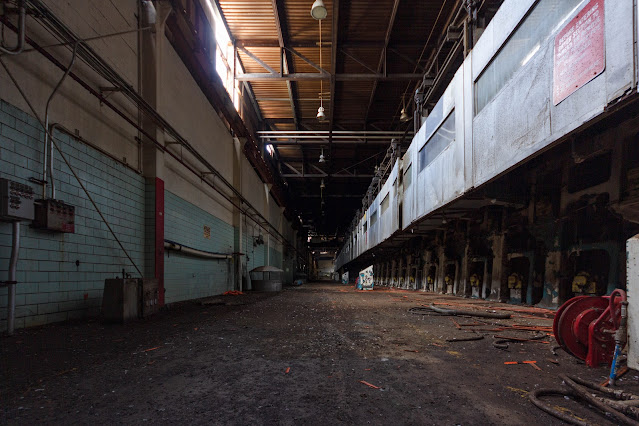
The main facility stretched out across two long buildings. Walking through them felt like wandering through the ribs of a giant beast. Down the center of the rooms ran deep drainage trenches. The very floor under my feet told the story of the daily grind. Workers had laid those red bricks at a perfect slope. Every drop of water and chemical effluent was designed to slide directly into the center trenches, straight into the polluted Cayadutta Creek.
One of the best discoveries was waiting on the far side of the factory. The massive wooden drums once used to tumble and tan the leather were still standing. Seeing them imperfectly intact felt like finding a dinosaur fossil hidden in plain sight. It was a rare glimpse into the physical labor that defined this region.
Fish in the Boiler Room
But the biggest shock was not industrial. It was biological.
Deep inside the dark, partially flooded boiler room, small fish swam through the green-tinged shallow water. They seemed completely unbothered by its concrete surroundings, treating the boiler room like a natural pond or spring. It reminded me of the feral goldfish that somehow claimed the flooded basement of Neponsit Beach Hospital in Far Rockaway, Queens. But these lone fish in upstate New York felt like true survivors.
How did they find their way into a factory boiler room? The answer required some patience.
During my final pass of the property, the mystery solved itself. Demolition crews had prepared the site, bushwhacking years of thick, tangled brush and tall trees. With the weeds and trees gone, a large holding pond sat exposed right next to the NY-30A highway metal railing. In my opinion, either heavy rains and severe floods likely swept the little fish from that holding pond or the nearby Cayadutta Creek right into the belly of the factory, or the holding pond itself, back channeled or flowed along the boiler room in a natural state so long ago defined before mankind arrested the land for commercial activity.
You cannot go looking for those fish today. You will not find the wooden tanning drums or the sloped brick floors either. The Cayadutta Tanning Company is officially gone as of April 2026. The holding pond, however, remains to this day. You can likely find some still thriving inside it.
The City of Gloversville, through a contractor bid, selected Bronze Contracting, which brought in heavy machinery and demolished the entire property. The goal is a common one in Rust Belt towns. City leaders hope a clean, empty lot will entice developers to invest and bring new life to the community.
How a Tannery Worked: Flesh, Lime, and Chromium
At its height, Gloversville boasted more than 100 leather and glove companies. The landscape was dotted with bustling operations like Maylender's Skin Mill, Pan American Tannery, Liberty Dressing Co., McDonough's Slaughter House, Maylender's Skin Mill, Brower Glue Manufacturing Co, D. M. Smith Co Hair Works, Leather Group Inc, Liberty Dressing Co., J. W. Hagadorn Skin Mill, J. V. and C. King Skin Mill, J. Q. Adams Skin Mill, H. P. M. Conkey & Co, Former Daniel Hayes Tannery, Risedorph Tannery, Van Tent Pole, Tradition Leather, Skin Mill, Gloverville Hair Co, Jos. E. Wood Leather Dressing Mill, D. Hays and Co. Skin Mill, M. J. Kennedy and Co. Skin Mill, Burr Bros. Sawing and Planing Mill, and Gloversville-Continental Mills.
So what happened to the glove capital of the world?
Creating all that supple and beautiful leather was a grisly, toxic business. Making gloves begins with turning raw animal hides into supple leather. Workers took cow, sheep, and deer skins and "fleshed" them, scraping away blood, tissue, and fat. They soaked the hides in lime to strip off the hair, then plunged them into chemical baths in a process called "bating" to make the leather soft. It was a harsh environment fueled by heavy chemicals like formaldehyde, chromium, and tannins.
The Creek That Changed Colors
For decades, the environmental cost was staggering. Before the Environmental Protection Agency (EPA) existed, tanneries pumped their waste straight into the nearby Cayadutta Creek. Every single day, two million gallons of sewage, household detergents, animal grease, flesh, hair, and chemical dyes were dumped in the creek. Locals swapped stories of the creek changing colors to match the latest glove fashions. The toxic water would churn and foam, creating sudsy crests ten feet high. For decades, the creek was completely dead, barren of fish or any other aquatic life.
The Clean Water Act and the Collapse
The fatal blow landed in 1972 with the federal Clean Water Act. The new environmental laws required factories to treat their own toxic runoff. The modern process is highly regulated. Today, tannery workers wear protective masks and gear, carefully managing chemicals such as chromium, so they are fully absorbed by the leather instead of being dumped down the drain. Treating tannery water now requires separating solids, removing sulfides, balancing the pH, and filtering the liquid multiple times before a single drop hits the municipal sewer system. For tanneries that were already losing business to cheaper overseas suppliers, spending a million dollars on a wastewater treatment system was unthinkable. Some borrowed heavily to buy the equipment, only to bleed out slowly over the next few decades. Most simply closed their doors. Yet the leather industry in Gloversville did not vanish completely. It just learned to adapt.
What Survives: Townsend, Samco, and the Last Glovemakers
The companies that survived share one common strategy. They abandoned mass production in favor of highly customized, premium work. Today, Townsend Leather in nearby Johnstown produces luxury upholstery for performance aircraft. Daniel Hannis, president of Adjon Inc., manages raw sheep and goat skins, turning them into high-end fashion and military gear. A newer business, Brooklyn Custom Leather Works, recently opened its doors to paint and stamp intricate patterns for interior designers.
Then there is Samco, one of the last true glove companies in town. They make leather dress gloves for the United States military, turning out more than 100,000 pairs a year. Every single pair is crafted by hand on traditional sewing machines.
Richard Warner, the company's co-owner, knows the business from the ground up. He started working in the glove trade straight out of high school in 1979. When previous owners Salvatore and Ila Greco wanted to expand their operations in 1996, they hired Warner as their superintendent. During its busiest modern years, Samco employed 75 people. Today, that number has dropped to 35. The decline is not due to a lack of orders or overseas competition. The real problem is finding people who actually know how to operate the vintage sewing machines. The old skills are fading away. You can read more on the last surviving glovemakers in the exceptional "In upstate New York, leather's long shadow" by author Debbie M. Price in Undark.
But as the physical monuments of the past fall, the surviving craftsmen in Gloversville keep the spirit of Stump City alive. They prove that while the town may no longer glove the entire world, it still knows how to make something that lasts.
Before 1870, Gloversville was just a rugged little village known as Stump City. When it was officially incorporated in 1853, the population sat at a modest 1,318 residents. But as local leather craftsmen began to set up shop, town leaders wanted a name that matched their ambition. They settled on Gloversville, and they had no idea just how accurate that name would become.
When the railroad arrived in 1870, the town exploded into an industrial powerhouse. At its peak, local factories made roughly 90 percent of all the gloves sold in America. People liked to say the town had more millionaires per person than any other city in the country. Whether that was true or just a local legend, one thing was certain. Leather made a lot of families incredibly wealthy, and it provided a paycheck for nearly everyone in town. The city even adopted a proud slogan that eventually spread across the globe: "Gloversville Gloves the World."
From Toxic Tanneries to Greek Yogurt
But as the traditional leather industry shrinks, Gloversville has found a brilliant, unexpected way to survive. The Cayadutta Creek is no longer a foaming river of chemical dyes. It is a sparkling and reinvigorated trout stream. The Mohawk River has also seen massive cleanup improvements. Together, they provide abundant, clean water. And ironically, the very thing that killed the tanneries is now saving the town.
When the local government built extensive water and sewer infrastructure to handle massive amounts of tannery waste, it laid the groundwork for a new era. Clean water and heavy-duty plumbing are exactly what modern food and dairy companies need. Fage USA recently opened a massive plant to make Greek yogurt. Euphrates followed suit to produce feta cheese. Even Pata Negra, a Spanish cured meat company, is now making chorizo right in Gloversville.
The Parkhurst Legacy and What Comes Next
The property started as a modest wooden factory run by the D.M. Smith Company, which processed hair and wool. Edward S. Parkhurst eventually took the helm, renaming the business to E.S. Parkhurst & Company in 1904. Ten years later, a massive fire burned the original wooden factory to the ground. The resilient brick structure that took its place is the one that stood for the next century.
The Parkhurst family treated their business as a community anchor. In 1918, they bought nearby Parkhurst Field, which remains the oldest continuous baseball field in the United States. They purchased the grounds to support their employees and give the local community a place to gather. Edward ran the mill until he died in 1926. His wife Marion steered the ship until 1956, and their son Richard took over until the business dissolved around 1970.
By the mid-1960s, the space was divided. G. Levor & Company leased a portion for leather manufacturing. Cayadutta Tanning Company moved into the facility in 1966 and eventually took over the whole block. In 1979, Rene Perrone bought Cayadutta Tanning to expand his own business, Liberty Leather. By 1984, he employed 250 people across two plants. But the math just did not work anymore. In 1985, the doors locked for good. The property was sold to a private entity, Comrie Avenue Inc. of Fultonville, in 1999, but the buildings sat empty for 41 years.
What comes next is up to the town. Residents want a mix of commercial spaces and green areas to complement the historic Parkhurst Field next door. They envision a hotel, a restaurant, or a lively local brewery. The empty dirt could become a dog park, an indoor sports facility, or extra parking to support weekend baseball tournaments. What comes next will now determine a new chapter from a wooden hair mill to a toxic tannery, to now a clean slate parcel lot. Only time will tell in the next few years.
🧤 Did You Work at Cayadutta Tanning or Any Gloversville Tannery?
Were you employed at the Cayadutta Tanning Company, E.S. Parkhurst & Company, Liberty Leather, or any of the hundred-plus tanneries and skin mills that once defined Gloversville? Do you have photos from inside the Pink Flamingo before its 2026 demolition, or memories of the Cayadutta Creek when it still ran with chemical dyes? With the factory now gone, your firsthand accounts are the living record of the glove capital of the world.
Drop a comment below or contact me directly. Full credit given to all contributors.
Source(s):
1. Pulitzer Center. (n.d.). Upstate New York: Leather’s long shadow. https://pulitzercenter.org/stories/upstate-new-york-leathers-long-shadow
2. Hughes, J. (2015, May 30). Gloversville tanneries fade away, but illness, pollution remain. Times Union. https://www.timesunion.com/news/article/gloversville-tanneries-fade-away-but-illness-8343901.php
3. Photo This. (2009, July 21). Abandoned leather factory – part 1/2 [Blog post]. WordPress. https://photothis.wordpress.com/2009/07/21/abandoned-leather-factory-part-1-2/
4. Glovers & Tanners Historical Society. (1970). 1970 directory of glove and tannery manufacturers [Historical directory]. http://www.gloversandtanners.com/1970_directory
5. The creek at Gloversville—a picturesque, meandering sewer. (1964, December 28). The New York Times, p. 22.
6. McAdam, T. (2026, March 27). Former Fownes buildings demolished in Gloversville, Cayadutta Tanning up next. Daily Gazette. https://www.dailygazette.com/leader_herald/news/business/former-fownes-buildings-demolished-in-gloversville-cayadutta-tanning-up-next/article_eb57a503-318b-4b1c-9ccb-918084d6c081.html
7. Landro, D. (n.d.). Cayadutta Tanning. Urbex Playground. Retrieved May 31, 2026, from https://www.urbexplayground.com/urbex/cayadutta-tanning
8. City of Gloversville. (2023, October). City of Gloversville, NY Brownfield Opportunity Area (BOA) nomination plan. New York State Department of State.
9. Fulton County. (2024, November). Building Fulton County's future: Housing, tourism and economic growth (2026-2030 development strategy). MRB Group.
10. City of Gloversville. (2023, November 2). U.S. Environmental Protection Agency Brownfields Multipurpose Grant application (FY2024) [Grant application]. U.S. Environmental Protection Agency.
11. Price, D. M. (2017, February 22). In upstate New York, leather's long shadow. Undark. https://undark.org/2017/02/22/leathers-long-shadow-gloversville-new-york/
-20.jpg)




Comments
Post a Comment