The neighborhood felt like a forgotten patchwork of empty industrial buildings, each one silently decaying next to the other. Years ago, walking past the block near the old Freihofer Wholesale and Retail Bakery Complex, I noticed that the gate I'd once found shuttered was now slightly open—just enough to slip under and explore. I couldn’t resist.
Inside, the first thing I saw stopped me in my tracks: graffiti by artists who had transformed this abandoned space into their gallery. The centerpiece was surreal and monstrous—a sprawling, gray figure with jagged yellow teeth, too many yellow eyes to count, two exposed red brains, and a long, blood-red tongue. It was a disturbing mix of body parts, like something conjured from a fever dream. This wasn’t a piece that could’ve been drawn sober; it had an intensity that felt born from wild imagination and maybe a little psychedelic inspiration.
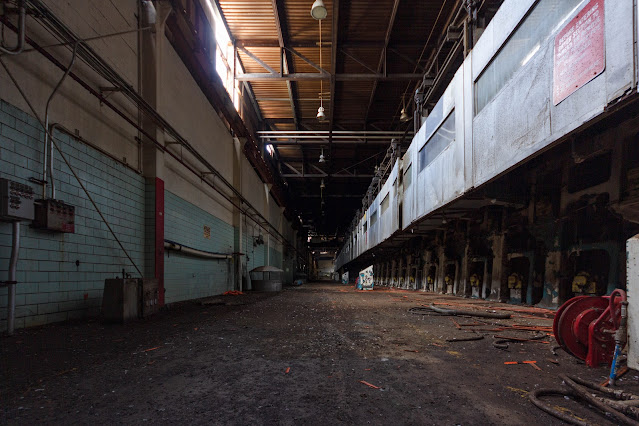
After taking in the scene, I moved farther inside. The rooms were filled with the usual debris—scraps of garbage and broken furniture, the remnants of long-ago illegal dumping. I snapped a few photos, but before long, I was back outside. I wish I had taken more exterior photos and had taken the opportunity to pull myself inside a basement window years ago, but we live and learn from regrettable mistakes.
The building layout was confusing. At one point, I thought I'd found a staircase leading to another section of the upper floor, expecting it to open onto a larger area. Instead, I found myself in a narrow room filled with wooden beams, holding up a section of the roof that let in bright shafts of daylight. There was no passage to the other side. It was a dead end, and I felt a pang of disappointment.
Defeated, I left, hoping the next stop—the former Steel Huddle Complex—might hold more promise. But luck wasn't on my side that day. Once again, I came up empty-handed.
Historical records and old Sanborn maps reveal a concentrated industrial history on this block, where several manufacturing companies once operated side by side. From the left of North 21st Street stood Ero Manufacturing Company, listed as an "Automotive Sporting Goods Manufacturer" in a 1910 survey and once known as Keller Manufacturing. In the center of the block was Woolford Tank Company, followed by Steel Units Manufacturing Company, with Good Bros Inc Food Products Warehouse anchoring the other end near North 20th Street. Today, this lot has been repurposed, with an entirely new business occupying the land.
Above these sites, on West Lippincott Street, lay the F.A. Depue Coal Yard, also known as McKeel Company Coal Yard, in 1910. Further, an NBS Special publication mentions Taylor Lock Co. once operating from 2034 W. Lippincott St.
In a twist of history, the former Steel Heddle Manufacturing Complex, which includes these industrial parcels, is currently for sale, covering 3101-19 N. 21st St, 2024-34 W. Lippincott St, and 2016 W. Lippincott St. This rare opportunity links past and present, offering a glimpse into the block's storied industrial legacy.
Sources:
1. NBS Special Publication. (1978). United States: The Bureau. pp.49.


-20.jpg)



is this still accessible?
ReplyDeleteThe whole block, save one active building at the end, has been leveled.
ReplyDelete