Beaton & Corbin: The Toxic Southington Factory

Before the plaza, there was a fire. Before the fire, there was a corporation that dissolved and left its contamination for the town to deal with. Before that, there was a vat of nickel-chrome solution laced with cyanide that cracked and leaked onto the concrete floor, and nobody around to take legal responsibility for the 500 gallons of it spreading across the building. And before any of that, for nearly a century, there was Beaton and Corbin.
 |
| It seems Beaton & Corbin started out manufacturing knives before producing plumbing products. |

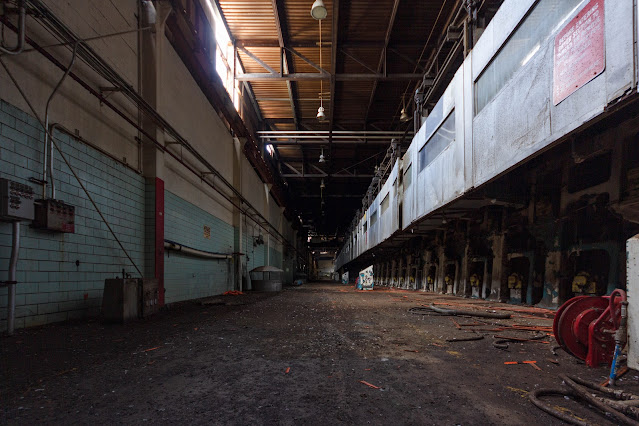
The property on North Main Street has been in industrial use since the late 1800s, when the Aetna Match Company occupied the site. By 1900, Beaton and Corbin had moved in. The company, formally incorporated in 1893, manufactured ceiling and floor plates along with plumbing fittings and fixtures. Its core operations were metal machining and metal plating, processes that produced, over the course of nearly ninety years, a steady accumulation of waste: metal hydroxide plating sludge, plating chemicals, degreasing oils, machining oils. The standard byproducts of a standard industrial operation. Two lagoons in the southwest corner of the property absorbed most of it.
The company ran into financial trouble in the 1980s and abandoned the building in 1989, owing the town more than $10,000 in back taxes on its way out. When Beaton and Corbin's corporation formally dissolved that same year, ownership of the property went into legal limbo. No one held clear title. No one was legally positioned to do anything with the site. The town of Southington was left with a contaminated three-acre parcel, a dissolving pile of back taxes, and no obvious path forward.
By the time anyone was in a position to address the mess, the back taxes had grown to more than $98,000.
What the company left behind was not simply neglect. In 1997, a consultant brought in to assess the property found groundwater contamination beneath the site and estimated that as much as 4,600 tons of soil had been polluted by petroleum products, solvents, and heavy metals, the accumulated result of decades of electroplating and machining work. Federal contractors, working at the state's request, removed industrial pollutants from the site that same year. The leaking cyanide-laced solution and 40 drums of various chemicals were hauled away. Asbestos removal followed in 2004, also conducted by federally hired contractors.


In between those two rounds of cleanup, in 2003, someone set the vacant factory on fire. The arson gutted what remained of the buildings, adding a layer of fire damage to a site already working through environmental remediation.
Through all of it, the town did not foreclose. The reason was straightforward: foreclosing would have transferred legal responsibility for the contamination to Southington itself. Whatever additional pollution might be found beneath the ground, whatever the cost of addressing it, the town would own that liability. It was not a position anyone in municipal government was eager to accept.
The solution came in the form of the Connecticut Brownfields Land Bank, a nonprofit entity designed specifically for situations like this one. The town transferred the land to the Land Bank, which created a legal buffer: if more contamination surfaced during redevelopment than anyone had anticipated, neither the town nor the eventual developer would be on the hook for it. The transfer was a mechanism for making the property developable without exposing either party to open-ended environmental liability.
From there, the town sold its tax liens to a developer named Mark Lovely, operating as 318 North Main Street, LLC. Through a triparty partnership, the property was foreclosed, and ownership, with clear legal title in hand, was able to pursue what the town itself could not: state and federal environmental remediation grants. The three-acre parcel received $400,000 in state grants to fund the cleanup.
The two lagoons in the southwest corner of the property are gone. The plating sludge, the cyanide solution, and the drums of chemicals are gone. The burned-out factory shell is gone. The $98,000 in back taxes that sat on the books for years while the property moldered in legal ambiguity is, presumably, settled.
In their place is a $1.5 million commercial plaza. B&V Jewelers. An ice cream shop. A medical office. A daycare.
It is the kind of ending that brownfield remediation advocates point to when making the case for the process: contaminated industrial land, written off as too expensive and too legally complicated to touch, converted into tax-generating commercial space through the right combination of grants, legal structure, a land bank and a developer willing to navigate the paperwork. The plaza on North Main Street is evidence that the process works.
The Forgotten Ledger Series #2
Over the years, I have built a long list of locations I meant to visit. Some were already abandoned and waiting. Others were still hanging on by a thread. Many of them are gone now. Demolished. Redesigned. Paved over. Erased from the map but not quite erased from memory. “The Forgotten Ledger” is where I go back to those missed chances. Each entry in this series will be a brief look at one of these places. You might see old notes, rough research, scraps of history, half-finished maps, or a single blurry photo taken from the road. Sometimes all that remains is a story from a local or a line in a newspaper. Other times, there are records of who owned the land, what was made there, and when it shut down for good.
While I work in the background on the larger, in-depth histories many of you have come to expect here, this series will help keep the pace steady. It gives me room to share more of the process. The near misses. The “almost” visits. The buildings that were struck from the ledger of time before I could arrive. Urban exploring changes fast. One day, a structure is just sitting there, empty but intact. The next day, it is a pile of bricks and dust. I hope that “The Forgotten Ledger” keeps these places alive just a little longer, even if only through memory and documentation.
Whether you ran the plating lines, worked the machining floor, or grew up in Southington watching the building sit empty and then burn in 2003 — those years between abandonment and the new commercial plaza are worth documenting. Factory floor photographs, employment records, memories of the Aetna Match Company era, or simply knowing what 318 North Main Street looked like before the lagoons were dug: any of it fills a gap that the DEP reports and tax lien records can't. The cyanide is gone. The story doesn't have to be.
More from Digital Ink'd
Beaton & Corbin Manufacturing Co. operated at 318 North Main Street in Southington, CT from 1893 until abandoning the site in 1989, leaving behind cyanide-laced plating waste, 40 drums of chemicals, and over $98,000 in unpaid back taxes. Following a 2003 arson fire and years of federal and state remediation, the 3-acre parcel was redeveloped with $400,000 in state grants into a commercial plaza now home to B&V Jewelers, an ice cream shop, a medical office, and a daycare.
Source(s):
1. Property transfer brings cleanup of polluted factory site in Southington one step closer. (2016, December 13). Hartford Courant. https://www.courant.com/2016/12/13/property-transfer-brings-cleanup-of-polluted-factory-site-in-southington-one-step-closer/
2. (1911) Sanborn Fire Insurance Map from Southington, Hartford County, Connecticut. Sanborn Map Company, Jul. [Map]. Retrieved from the Library of Congress, https://www.loc.gov/item/sanborn01178_006/
3. Reward offered in fire probe. (2004, January 9). Hartford Courant. https://www.courant.com/2004/01/09/reward-offered-in-fire-probe/
4. Southington discusses Beaton & Corbin factory. (2015, October 13). Hartford Courant. https://www.courant.com/2015/10/13/southington-discusses-beaton-corbin-factory/
5. Southington moving to clean polluted factory site. (2016, January 27). Hartford Courant. https://www.courant.com/2016/01/27/southington-moving-to-clean-polluted-factory-site/
6. Local man is charged in 2003 factory blaze. (2005, September 15). Hartford Courant. https://www.courant.com/2005/09/15/local-man-is-charged-in-2003-factory-blaze/
7. (1895) Sanborn Fire Insurance Map from Southington, Hartford County, Connecticut. Sanborn Map Company, Oct. [Map]. Retrieved from the Library of Congress, https://www.loc.gov/item/sanborn01178_003/
8. Jacobs, F., photographer. (1942) Untitled photo, possibly related to: Southington, Connecticut. The Beaton and Corbin Manufacturing Company. Southington, Connecticut, Hartford County, United States, 1942. -30. [Photograph] Retrieved from the Library of Congress, https://www.loc.gov/item/2017865112/
9. Arcadis U.S., Inc. (2020, August). Analysis of brownfields clean-up alternatives: 318 North Main Street, Southington, Connecticut (Project No. 30049879). https://www.southington.org/DocumentCenter/View/3181/ABCA_318-North-Main-Street-Southington-CT_Final_with-attachments-PDF
10. Hardware World Publishing Co. (1918). Hardware World (Vol. 13, Nos. 7–12). https://archive.org/details/HardwareWorldVol13No712
11. Hardware World Publishing Co. (1917). Hardware World (Vol. 12, Nos. 3, 10–12). https://archive.org/details/HardwareWorldVol12No31012
12. The Plumbers and Heating Contractors Trade Journal, 83. (1927). Plumbers Trade Journal Publishing Co. https://archive.org/details/plumbersheatingc8319unse
-20.jpg)



Comments
Post a Comment