Our platform is the most extensive digital repository of the Northeast's historic, at-risk, and overlooked structures, infrastructure, New York City streets, and other locations.
Kings Park and the Education of an Explorer Every pursuit has a place where beginners go first. Skateboarders have their parking lots and curbs. Climbers have their local crags. And if you are just finding your way into the world of urban exploration on Long Island, sooner or later someone points you toward Kings Park. The former Kings Park Psychiatric Center has become, over the years, something like a finishing school for people who don't yet know they're enrolled. Getting onto the grounds is straightforward. Finding a way inside the remaining buildings, if you know where to look, is not much harder. Which is exactly why the Parks Police have written thousands of trespassing tickets here in a single calendar year, why security visibly tightens every Halloween, and why local photography groups have been known to show up with large, enthusiastic crowds of people who want to take what they call "creepy" photos of old hospital asylums. The place attracts everyone, which...
Get link
Facebook
X
Pinterest
Email
Other Apps
Abandoned Pigeon Church: Forgive Us For Our Trespass
Get link
Facebook
X
Pinterest
Email
Other Apps
Pulpit Views
🏗️ Development Update — 64 Norfolk Street
The site of the former Beth Hamedrash Hagadol synagogue, destroyed by a three-alarm fire on May 14, 2017, has been transformed into 64 Norfolk Street — a new affordable housing development on the Lower East Side. What was once a 167-year-old Gothic Revival sanctuary is now a modern residential building, part of the neighborhood's ongoing evolution.
Finding this abandoned church of worship was pretty easy. The exact location of this former house of worship would surprise many urban explorers. It's located right in the heart of a rather busy neighborhood surrounded by so many changes. I won't go into detail on the history of this place since it is quite a gem once inside. Let us begin on my mission to get inside this place of God.
It took me four scouting missions to finally realize that what I thought was the entrance was not actually the entrance until on my third scouting mission I realized there was the entrance on the other side staring me in the face. From then, I knew I had to explore this church on all days of the week; a Sunday. The day of rest and worship. The irony finally came to me while drafting this exploration report.
Upper Balcony View
Pulpit
Center of Religious Indoctrination aka Central bimah
Once inside this grand and former religious institution, I was joined by a different flock of congregants. They made their presence known cooing and flapping around my head as daylight began to trickle inside. I could already tell that these faithful pigeons had made it inside their home. Large quantities of pigeon feces were everywhere. It would take large and extensive renovations to fix this epic mess. The pigeons had already made a cozy home within the holes of the roof. Plaster and roofing materials had already come down in some places. Looking up you good see this church was a grand and beautiful house where many came to worship. The elaborate banister and ceiling tiles on the ground floor were intricate and symbolic. Seating numbers were etched in seating cushions.
Numbered Seating Arrangements
Once majestic ceiling.
Views from the middle of church seating.
One point of note was there was no awful graffiti as some abandoned churches have been desecrated by unmoved artists angering local and historical preservationists to no end. No piping or artifacts seemed to have been absconded with into the night. A large selection of religious texts was still on shelves and down in the basement many more were sitting unopened. As the many pictures showcasing this "church", I took no pictures of the basement. Why do you ask? Well, down in the basement I came across some rather large rodents scuttling around without fear. I quickly took some video and headed back up. No rodent was going to fight me for pictures.
Beautiful architecture.
Church selfie? Am I going to hell?
Much of the property stood as the day the doors were finally closed to the last of the faithful congregants. Drapes were still in place and religious texts covered in mounds of pigeon feces lay open with no one to read from them to the ears of the faithful. I would assume the sacred and most cherished prized possession of this institution was probably removed a long time ago. I certainly didn't look for it.
Where I like to sit in church most of the time.
When the religious literature puts you in a state of eternal slumber.
Seating pews gave phenomenal views all around wherever you sat for worship. The rounded seating gallery arrangement was added for the women.
In the end, only time will tell what happens to this property. The ravenous appetite of property developers will have to wait a little longer as the property deteriorates even further by the elements until demo day arrives. Let us forgive those who trespass against us...
Usher views.
🕍 More NYC Sacred Spaces & Lost Landmarks
From synagogues and churches to abandoned hospitals and hidden infrastructure — explore the layers of history buried throughout New York City.
The text message from my friend J was simple: a list of addresses in Newark and Paterson. An invitation. An urban treasure map with Xs marking forgotten places. I picked the one on Piercy Street. Pulling up, I saw the building wasn’t exactly hiding. It was a behemoth of brick and colorful lettered graffiti, a whole city block of decay. A door gaped open next to an old loading dock, but the scene gave me pause. Mounds of illegally dumped trash lay along the floor of the loading bay. This part of Paterson has a tough reputation, and the open doors felt less like an invitation and more like a dare. I took a deep breath and stepped inside. The air was thick with the smell of dust and damp. I found myself in a vast, open space littered with plastic containers and skeletal metal shelving. I moved deeper, drawn toward the old boiler house section. Before I reached it, I walked into a room that stopped me cold. Everything was stained a deep, blood red. A fine crimson powder coated the fl...
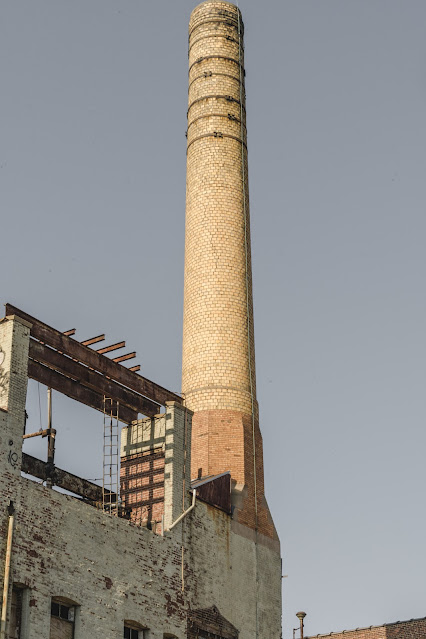
A former coal-fired power plant in Yonkers sits quietly by the waterfront, its redevelopment ambitions repeatedly running aground against community resistance and logistical hurdles. Once an industrial hub, the site has spent years in limbo, tangled in unrealized visions of transformation and contention with local stakeholders. The most recent development proposal called for a 157,000-square-foot mixed-use office space. However, the Yonkers Planning Board faced strong pushback from residents. Parking became a flashpoint, with the community voicing concerns over how the new project would accommodate vehicles. Efforts by the developer to secure parking access at nearby Trevor Park and the John F. Kennedy Marina were met with such resistance that the plans were scrapped altogether. Adding to the tensions, critics took issue with the property owner's financial contributions to the city. Many residents felt the developer had been avoiding paying a fair share of Yonkers' property tax...
The Last Days of Nearpara Rubber I smelled it before I saw anything worth photographing. That warm, faintly sweet bite of old rubber, the kind that hits you somewhere between a tire shop and a summer highway, drifted through the first building the moment I stepped inside. The structure was burned out, charred and broken, rubble underfoot. But the smell was alive. And then I saw the pile. In the corner of the room, faded brown and heaped maybe two feet high, was a mound of baby bottle nipples. Dozens, maybe hundreds, of the small rubber tips, just sitting on the floor of a collapsed industrial building in Trenton, New Jersey. I stood there for a moment, genuinely confused, and then kept moving. Nothing like the smell of warmed-over rubber. Twenty minutes later, I understood even less. Through another door passage, I found the main source of the smell: six open metal trailer containers, still loaded with bagged baby bottle nipples, sitting in open air. Bags of them, mountains of bagged n...
For weeks, I had been orbiting the perimeter of the impending demolition of the Church of St. Michael and St. Edward, a once revered church in the heart of Fort Greene, like a moth drawn to a flame. The neighborhood, a patchwork of tight project housing, seemed indifferent to the fate of this historic edifice. The intel I had received suggested that entry was as simple as scaling a wooden fence, yet the timing had never felt right. Until one day, it did. With a mission in New Jersey looming, I knew it was now or never. The demolition was advancing at a startling pace, the church's twin steeples already reduced to rubble. The skeletal remains of timber beams and rusted steel frames peeked out from the ruins, a testament to the relentless march of progress. Summoning a surge of courage, I seized a moment of quiet in the bustling housing project and vaulted over the fence. My heart pounded in my chest as I slipped unnoticed into the church grounds. The once grand entrance now stood as...
🏗️ Development Update — The Highland at East New York Update May 2024. The redevelopment of the former Empire State Dairy complex is now complete. The Highland development has risen from the bones of the old milk factory and is now one of Brooklyn's most recently landmarked buildings . The residence spans 14 stories and offers studio, one-, two-, and three-bedroom homes. Rents start around $2,400 and climb from there . If you can call that affordable housing, I have a NYC mansion to sell you off Flatbush Avenue. The Architecture The property in question encompasses 0.72 acres, bordered by Schenck Avenue to the west, residential properties to the south, Barbey Street to the east, and Atlantic Avenue to the north. This site boasts a rich history of diverse commercial and industrial uses. Dating back to the 1890s, it served as a dairy bottling facility before accommodating companies such as the Royal Plastics Corporation and/or Allied Til...
-20.jpg)



Comments
Post a Comment